Articles from July 2007

After pratting around with DOOM with MDX, it's logical to move up to Quake with XNA. After all, the levels are "true" 3D, and there's a healthy amount of new textures (including bump and gloss maps) so that it would make creating an advanced engine easier. My problem is always finding resources.

On the subject of resources, I'm using a system whereby the various classes for game resources (such as the Level or Model class) can implement ResourceLoader.ILoadable<T>, so I can do things like this:

ResourceLoader = new ResourceLoader(@"C:\Program Files\Quake\ID1");

Palette DefaultPalette = ResourceLoader.Load<Palette>("gfx/palette.lmp");
Level SomeLevel = ResourceLoader.Load<Level>("maps/start.bsp");

This way the ResourceLoader can handle dragging data out of multiple pack (.pak) files or loading override files.

First things first - loading levels. This is nice and easy (unlike DOOM) - the .bsp files contain a list of vertices and a list of edges (each edge contains a start and end vertex index). For testing purposes, I used the Graphics class to draw out each level in 2D:
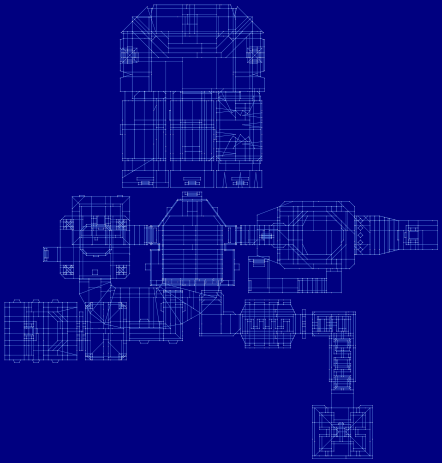
start_blueprint.png

Next up, I create a point list and render those in 3D:

points.jpg

...and now the edges as a line list:

wireframe_on_side.jpg

That seems to be on its side. Quake uses (x, y) as a 2D floor plan and z for height, so I need to swap z and y (and negate y whilst we're at it).

wireframe_correct.jpg

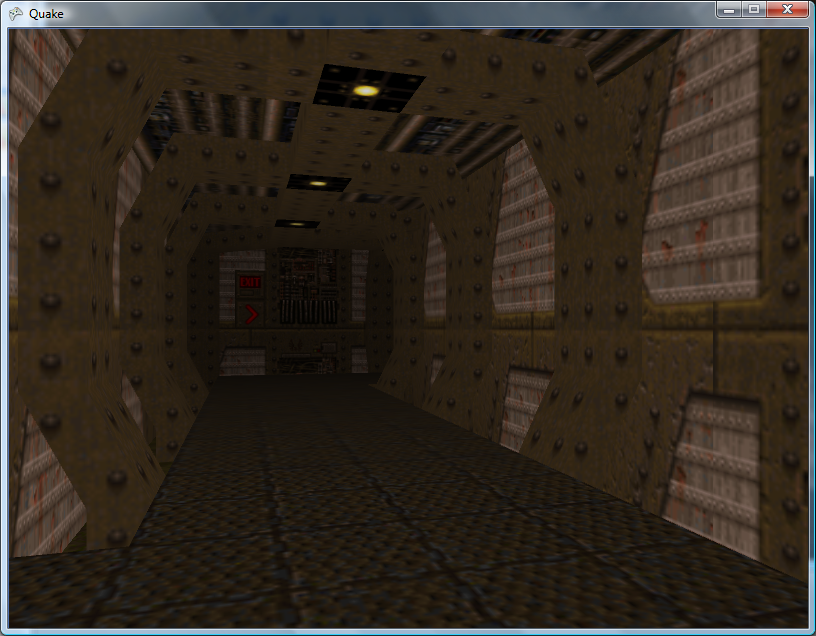
Quake uses faces for solid walls, which are simply convex polygons made up from lists of the aforementioned edges (and may have more than three sides). I'm creating a simple triangle list, and applying some fog to make the world look 3D (there's no lighting):

triangles_1.jpg   triangles_2.jpg

Texturing would make a welcome addition. Quake uses a rather novel texture coordinate system (at least, I've never seen anything quite like it) whereby each face references a TextureInfo structure, which contains the index of the texture itself, a pair of vectors indicating the horizontal and vertical axis (for aligning the texture against the surface of the face) and an offset in texels (so the texture can be aligned to the edges of the face). Fortunately, the BSP documentation I have indicates how to use this information to calculate the texture offset per-vertex, and by dividing by the texture's width and height I can get "conventional" texture coordinates.
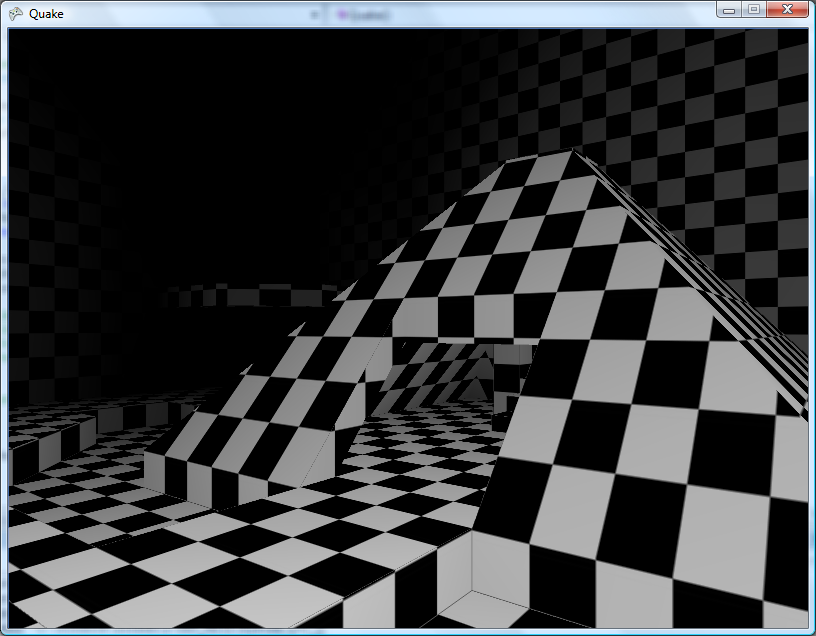
texture_checkboard.jpg

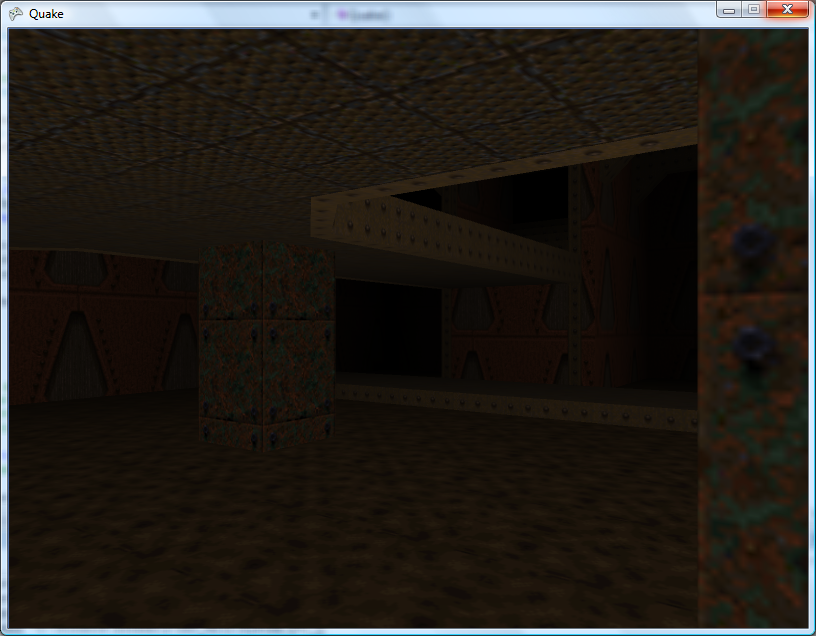
The real Quake textures would be nice, I suppose. As I break up the faces into triangle indices, I group them by texture index. The final triangle list is made up of groups of triangles by texture, so that (for example) triangles 0 to 10 will be texture 0, triangles 11 to 14 will be texture 1, triangle 15 will be texture 2 and so on. I also maintain a list of which triangles use which texture, so to render I simply set the texture, draw a range of triangles from the single list, then move on to the next texture.
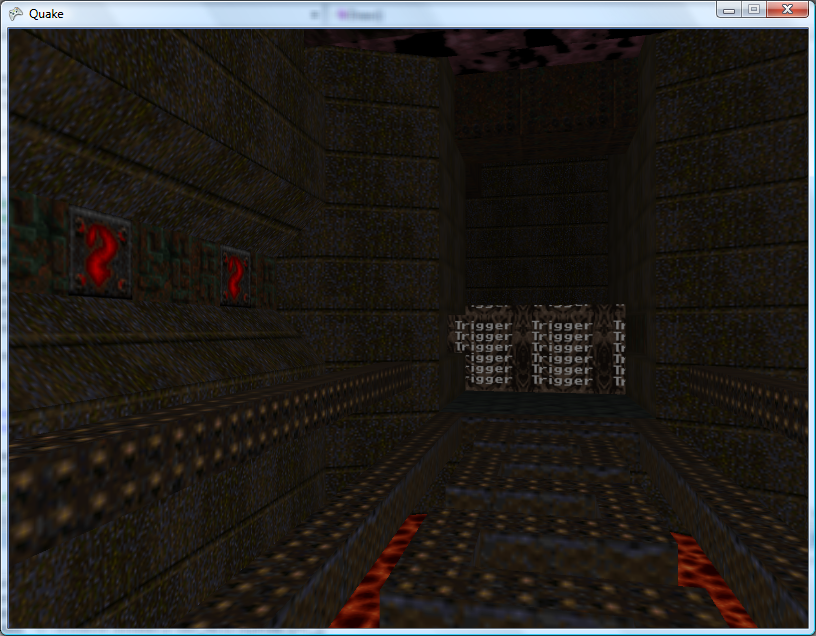
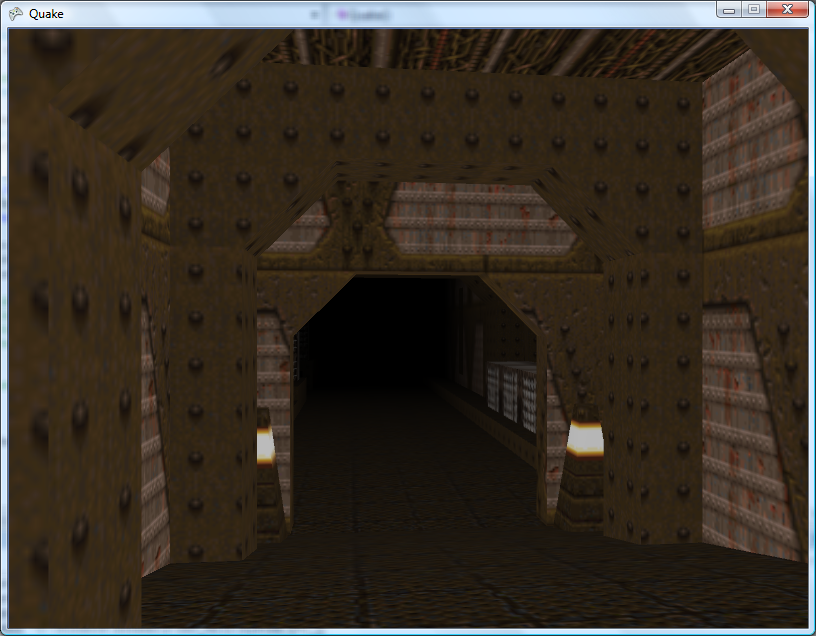
textured_3.jpg   textured_4.jpg

textured_5.jpg   textured_6.jpg

It's all pretty brute-force stuff at the moment, but it's still very fast on modern hardware. Next up will be lightmaps. smile.gif

Edit: The following code has a bug in it. Please make sure you use the corrected code!


After a conversation with Thevenin regarding the Game class in XNA not letting you use event-driven keyboard input (useful, for example, for entering text) I rolled out this monstrosity.


/* * * * * * * * * * * * * * * * * * * * * * * * * * * * * * * * * * * * * * * * * * * * * * *
 * XnaTextInput.TextInputHandler - benryves@benryves.com                                     *
 * * * * * * * * * * * * * * * * * * * * * * * * * * * * * * * * * * * * * * * * * * * * * * *
 * This is quick and very, VERY dirty.                                                       *
 * It uses Win32 message hooks to grab messages (as we don't get a nicely wrapped WndProc).  *
 * I couldn't get WH_KEYBOARD to work (accessing the data via its pointer resulted in access *
 * violation exceptions), nor could I get WH_CALLWNDPROC to work.                            *
 * Maybe someone who actually knows what they're  doing can work something out that's not so *
 * kludgy.                                                                                   *
 * * * * * * * * * * * * * * * * * * * * * * * * * * * * * * * * * * * * * * * * * * * * * * *
 * This quite obviously relies on a Win32 nastiness, so this is for Windows XNA games only!  *
 * * * * * * * * * * * * * * * * * * * * * * * * * * * * * * * * * * * * * * * * * * * * * * */

#region Using Statements
using System;
using System.Runtime.InteropServices;
using System.Windows.Forms; // This class exposes WinForms-style key events.
#endregion

namespace XnaTextInput {

	/// <summary>
	/// A class to provide text input capabilities to an XNA application via Win32 hooks.
	/// </summary>
	class TextInputHandler : IDisposable {

		#region Win32

		/// <summary>
		/// Types of hook that can be installed using the SetWindwsHookEx function.
		/// </summary>
		public enum HookId {
			WH_CALLWNDPROC = 4,
			WH_CALLWNDPROCRET = 12,
			WH_CBT = 5,
			WH_DEBUG = 9,
			WH_FOREGROUNDIDLE = 11,
			WH_GETMESSAGE = 3,
			WH_HARDWARE = 8,
			WH_JOURNALPLAYBACK = 1,
			WH_JOURNALRECORD = 0,
			WH_KEYBOARD = 2,
			WH_KEYBOARD_LL = 13,
			WH_MAX = 11,
			WH_MAXHOOK = WH_MAX,
			WH_MIN = -1,
			WH_MINHOOK = WH_MIN,
			WH_MOUSE_LL = 14,
			WH_MSGFILTER = -1,
			WH_SHELL = 10,
			WH_SYSMSGFILTER = 6,
		};

		/// <summary>
		/// Window message types.
		/// </summary>
		/// <remarks>Heavily abridged, naturally.</remarks>
		public enum WindowMessage {
			WM_KEYDOWN = 0x100,
			WM_KEYUP = 0x101,
			WM_CHAR = 0x102,
		};

		/// <summary>
		/// A delegate used to create a hook callback.
		/// </summary>
		public delegate int GetMsgProc(int nCode, int wParam, ref Message msg);

		/// <summary>
		/// Install an application-defined hook procedure into a hook chain.
		/// </summary>
		/// <param name="idHook">Specifies the type of hook procedure to be installed.</param>
		/// <param name="lpfn">Pointer to the hook procedure.</param>
		/// <param name="hmod">Handle to the DLL containing the hook procedure pointed to by the lpfn parameter.</param>
		/// <param name="dwThreadId">Specifies the identifier of the thread with which the hook procedure is to be associated.</param>
		/// <returns>If the function succeeds, the return value is the handle to the hook procedure. Otherwise returns 0.</returns>
		[DllImport("user32.dll", EntryPoint = "SetWindowsHookExA")]
		public static extern IntPtr SetWindowsHookEx(HookId idHook, GetMsgProc lpfn, IntPtr hmod, int dwThreadId);

		/// <summary>
		/// Removes a hook procedure installed in a hook chain by the SetWindowsHookEx function. 
		/// </summary>
		/// <param name="hHook">Handle to the hook to be removed. This parameter is a hook handle obtained by a previous call to SetWindowsHookEx.</param>
		/// <returns>If the function fails, the return value is zero. To get extended error information, call GetLastError.</returns>
		[DllImport("user32.dll")]
		public static extern int UnhookWindowsHookEx(IntPtr hHook);

		/// <summary>
		/// Passes the hook information to the next hook procedure in the current hook chain.
		/// </summary>
		/// <param name="hHook">Ignored.</param>
		/// <param name="ncode">Specifies the hook code passed to the current hook procedure.</param>
		/// <param name="wParam">Specifies the wParam value passed to the current hook procedure.</param>
		/// <param name="lParam">Specifies the lParam value passed to the current hook procedure.</param>
		/// <returns>This value is returned by the next hook procedure in the chain.</returns>
		[DllImport("user32.dll")]
		public static extern int CallNextHookEx(int hHook, int ncode, int wParam, ref Message lParam);

		/// <summary>
		/// Translates virtual-key messages into character messages.
		/// </summary>
		/// <param name="lpMsg">Pointer to an Message structure that contains message information retrieved from the calling thread's message queue.</param>
		/// <returns>If the message is translated (that is, a character message is posted to the thread's message queue), the return value is true.</returns>
		[DllImport("user32.dll")]
		public static extern bool TranslateMessage(ref Message lpMsg);


		/// <summary>
		/// Retrieves the thread identifier of the calling thread.
		/// </summary>
		/// <returns>The thread identifier of the calling thread.</returns>
		[DllImport("kernel32.dll")]
		public static extern int GetCurrentThreadId();

		#endregion

		#region Hook management and class construction.

		/// <summary>Handle for the created hook.</summary>
		private readonly IntPtr HookHandle;

		/// <summary>Create an instance of the TextInputHandler.</summary>
		/// <param name="whnd">Handle of the window you wish to receive messages (and thus keyboard input) from.</param>
		public TextInputHandler(IntPtr whnd) {
			// Create the keyboard hook:
			this.HookHandle = SetWindowsHookEx(HookId.WH_GETMESSAGE, new GetMsgProc(ProcessMessages), IntPtr.Zero, GetCurrentThreadId());
		}

		public void Dispose() {
			// Remove the hook.
			if (this.HookHandle != IntPtr.Zero) UnhookWindowsHookEx(this.HookHandle);
		}

		#endregion

		#region Message processing

		private int ProcessMessages(int nCode, int wParam, ref Message msg) {
			// Check if we must process this message (and whether it has been retrieved via GetMessage):
			if (nCode == 0 && wParam == 1) {

					// We need character input, so use TranslateMessage to generate WM_CHAR messages.
					TranslateMessage(ref msg);

					// If it's one of the keyboard-related messages, raise an event for it:
					switch ((WindowMessage)msg.Msg) {
						case WindowMessage.WM_CHAR:
							this.OnKeyPress(new KeyPressEventArgs((char)msg.WParam));
							break;
						case WindowMessage.WM_KEYDOWN:
							this.OnKeyDown(new KeyEventArgs((Keys)msg.WParam));
							break;
						case WindowMessage.WM_KEYUP:
							this.OnKeyUp(new KeyEventArgs((Keys)msg.WParam));
							break;
					}

			}

			// Call next hook in chain:
			return CallNextHookEx(0, nCode, wParam, ref msg);
		}

		#endregion

		#region Events

		public event KeyEventHandler KeyUp;
		protected virtual void OnKeyUp(KeyEventArgs e) {
			if (this.KeyUp != null) this.KeyUp(this, e);
		}

		public event KeyEventHandler KeyDown;
		protected virtual void OnKeyDown(KeyEventArgs e) {
			if (this.KeyDown != null) this.KeyDown(this, e);
		}

		public event KeyPressEventHandler KeyPress;
		protected virtual void OnKeyPress(KeyPressEventArgs e) {
			if (this.KeyPress != null) this.KeyPress(this, e);
		}

		#endregion
	}
}

The demo application will not support drawing characters that aren't provided in the sprite font (so it's a very bad demo), but it's the above class that's the useful bit of the package. It generates KeyDown, KeyUp and KeyPress events like WinForms controls.


Might be useful if your Windows game needs text input. smile.gif Win32 veterans, feel free to lambast my lack of skills.

Page 2 of 2← 1 2

Oldest postsOlder postsNewer postsNewest postsRSSSearchBrowse by dateIndexTags